EDUCATION SECTOR POLICY SUMMARY
What is Education Policy ?
Education Policy is a guiding document that outlines major principles and guidelines that are needed to achieve Education goals at all levels.
Why Education Sector Policy review?
There has been changes in Education Sector triggered by country’s aspirations, vision and goals. This calls for an education policy designed to cater for the country’s ambitions and the changing global landscape. This is why the 2003 policy is being reviewed.
Click here if you want to contribute to this review
Education Sector Policy Vision:
To be the strongest pillar and catalyst of Rwanda’s transformation by providing Rwandans with quality knowledge, skills, competences and values.
Education Sector Policy Mission:
To transform Rwandans into skilled and competent human capital by providing them with inclusive and equitable quality education, relevant labour market skills and lifelong learning, anchored on Rwandan values.
Education Sector Policy Focus Areas:
-
Rwandan values
The new policy is anchored on Rwandan values; ‘indangagaciro’ such as Self-dignity (Agaciro), Self-reliance (Kwigira), Work well done (Umurimo Unoze). -
No one is left behind
The new policy is dedicated to ensuring that no one is left behind. -
Right skills and competences for current and future market
The new policy aims at providing necessary and sufficient skills and competences for current and future market. -
‘Teachers First’
The role of teachers is an unnegotiable precondition for success of any quality education at all levels.
Education Sector General Framework:
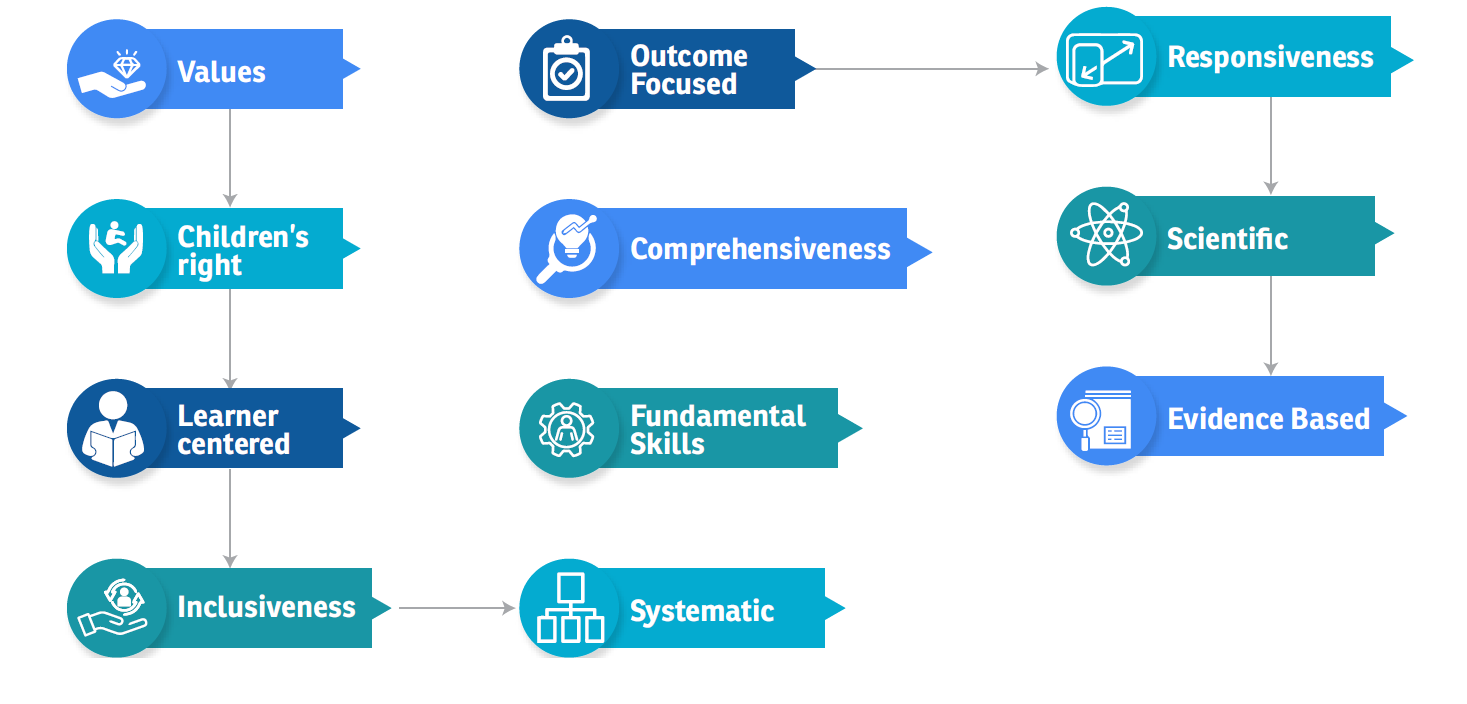
Policy Guiding Principles
Education Sector Policy Objectives:
- Each learner acquires education anchored on Rwandan values, with mastery of strong learning foundations in key life skills, strong literacy and numeracy from early ages.
- All learners access pre-primary education, start primary at the right age, attend and complete basic education in the expected number of years.
- Health and safety: Nutritional (school feeding), physical and mental wellbeing of learners are key. Other elements include; sanitation, environment and preparedness to deal with unforeseen circumstances.
- High level learning outcomes realized through the Competence Based Curriculum (CBC), Comprehensive Learning Assessment (CLA) and effective use of English as the medium of instruction.
- Improving Special Needs and Inclusive Education (SN&IE) and ensure all learners realize their full potential.
- Science Technology Engineering and Mathematics (STEM) strengthened through modern mechanisms of teaching, learning and assessment.
- Revitalized TVET and High Learning institutions to ensure right match of graduate and labour market skills and competences.
- Reformed Pre-service Teacher Training and Continuous Professional Development (CPD) including school-based peer learning and Career Guidance and Counselling (CG&C) system.
- Reinforced Partnership with Education Stakeholders in services provision and in strengthening Academia Industry link (AIL).
- Effective and efficient education system, institutional leadership, management, credible planning and robust M&E
